Eternal Movement I & II (Draaiingen)
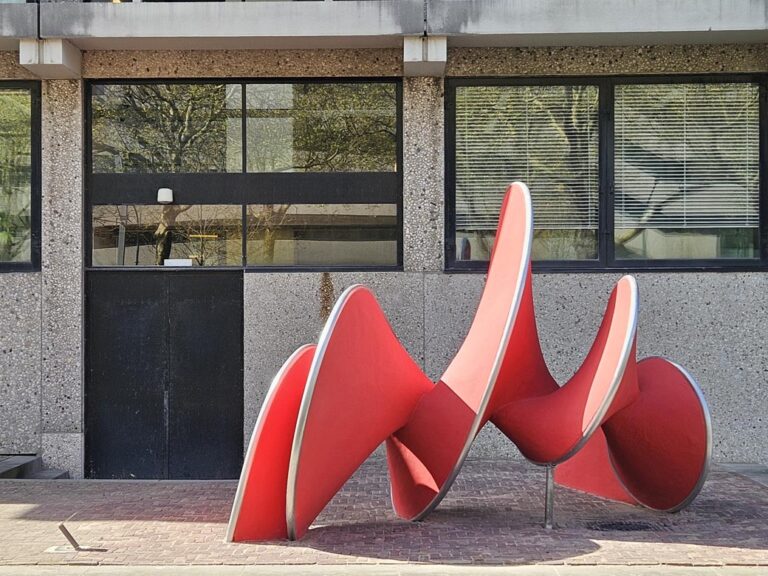
Anyone wishing to fully appreciate Draaiingen II would do well to travel from the VU Campus in Amsterdam, The Netherlands, where the sculpture is installed, to Enschede. At Rijksmuseum Twenthe, its predecessor, Draaiingen I (1989), is on display. Ideally, the journey would then continue to Cappadocia in Turkey, where Barbara Nanning found the inspiration for both works. During her travels through the chalk-white landscape, she became captivated by the eroded rock formations—bare, sculptural, and monochrome.
As a student at the Gerrit Rietveld Academy, apprenticed to the renowned ‘master potter’ Janvan der Vaart, Nanning had practiced in making pots and vases. Before long, however, these forms evolved into increasingly abstract objects in which the circle became the central motif. She called the works she created shortly after her visit to Turkey Fossil Forms, a series that was subsequently exhibited at the Stedelijk Museum, Amsterdam.
For this series, she wrapped unglazed ceramic vessels with rope and tightened it, creating a rhythmic pattern of constrictions and bulges. She continued manipulating the volumes until a
spiral-like form emerged.
Not through the door
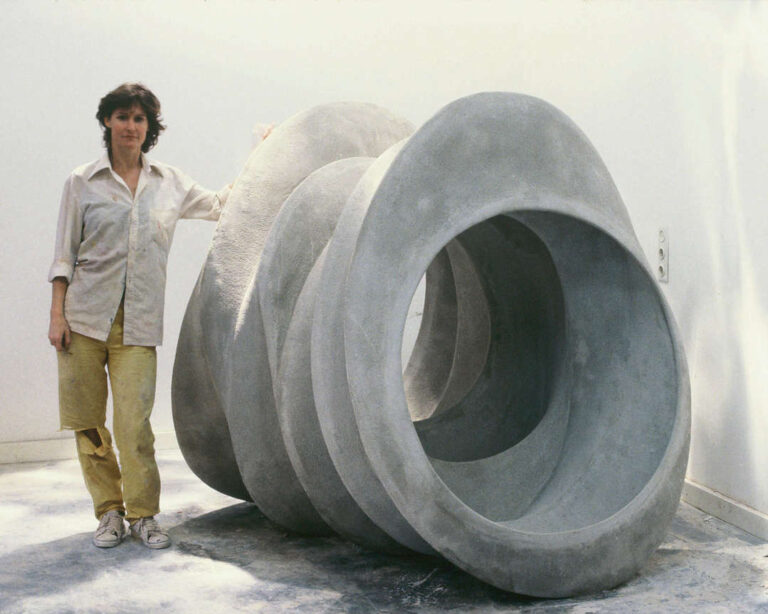
This working method also formed the point of departure for Draaiingen I, though on a far larger scale. Nanning stretched cords from wall to wall, constructing within this web a framework of steel wire and expanded metal mesh. She coated the structure with cement mortar and gradually sculpted it into shape. It was physically demanding work, requiring both an angle grinder and a welding machine.
Once the sculpture was finished, it turned out not to fit through the door. Only when it was finished did she discover that it would not fit through the studio door. A crane had to be brought in to lift Draaiingen I out through the window of her studio.
Three years later, the work in Enschede found its counterpart in Amsterdam, when the Vrije Universiteit commissioned Nanning to create what would become Draaiingen II. Instead of
concrete grey, this sculpture was executed in a deep matte red. It is even larger than its predecessor and unfolds as a horizontally elongated variation of the earlier form. It seems to have neither beginning nor end. As the eye follows one of its sweeping curves toward the edge, the form naturally curls back into itself. It evokes a giant screw, or a wave caught halfway between motion and stillness. Or perhaps an organically shaped crankshaft, thrust upward from the depths of the earth, yet yearning to return below the surface to keep the planet turning.


A Giant Block of Polyurethane Foam
The story of Draaiingen II did not end there. In 2007, a delegation from Japan’s Ministry of Land, Infrastructure, Transport and Tourism visited the VU Campus. Deeply impressed by this powerful evocation of the Earth’s elemental forces, the visitors commissioned a work inspired by the same vision. The result was Monument Mount Fuji. Unlike Draaiingen I and II, this sculpture was designed using digital 3D technologies and fabricated on the other side of the world from a single monumental block of polyurethane foam —a striking departure from the intensely physical, hand-crafted process that gave rise to the earlier works.
To see the outcome for yourself, however, you will have to travel to Gotemba.
Edo Dijksterhuis